


A story we keep getting wrong
Esports are everywhere. Competitive video gaming has become a routine part of life for hundreds of millions of people around the world, particularly young people and young men. Alongside its rapid growth, concerns about mental health have grown just as quickly. Depending on who you ask, esports is either a powerful space for connection and skill development or a risky environment linked to stress, burnout, unhealthy gaming habits and problematic ways of relating.
These narratives are familiar. None feel fully satisfying.
That tension raises a simple question: what do we actually know about esports and mental health? The data shows us that two things can be true at once.
Why esports mental health is so hard to talk about
Public discussions about esports mental health often slip into a good-versus-bad framing. Esports is portrayed as either a solution to social isolation or a driver of psychological harm. These simplified narratives are tempting, but they don’t align with players’ lived experiences or the current state of the science.
Esports is not one thing. It includes different games, competitive levels, cultures, and motivations for play. Mental health is also dynamic, involving wellbeing, stress, coping, and vulnerability that change over time. When these systems interact, simple answers rarely hold.
This is precisely why evidence matters, and why we need to look at the field as a whole rather than cherry-picking individual studies, anecdotes or media coverage.
What our team set out to do
Before developing mental health guidelines for esports, we first needed to understand the full landscape of existing research. We recently published a review that mapped all available evidence on mental health and wellbeing in esports players.
This review represents the largest synthesis of esports mental health research to date. As a scoping review, we systematically mapped the landscape of existing research, identifying key themes, methods, populations, and gaps, to clarify what the evidence base can and cannot yet support.
What we know
Esports mental health research has grown rapidly in recent years, reflecting broader interest from players, parents, educators, and industry stakeholders. The evidence consistently shows a mixed picture. Esports participation has been associated with positive outcomes such as social connection, skill development, and a sense of purpose. At the same time, studies also report links with stress, performance pressure, online harassment, sleep disruption, and symptoms of anxiety or burnout.
Importantly, wellbeing and distress often appear together. Esports players can experience high engagement, motivation, and enjoyment alongside psychological strain. Mental health in esports is not a simple trade-off, and it cannot be reduced to a single score or label.
What we don’t know, and why that matters
Despite this growing body of work, there are important limits to what the current evidence can tell us.
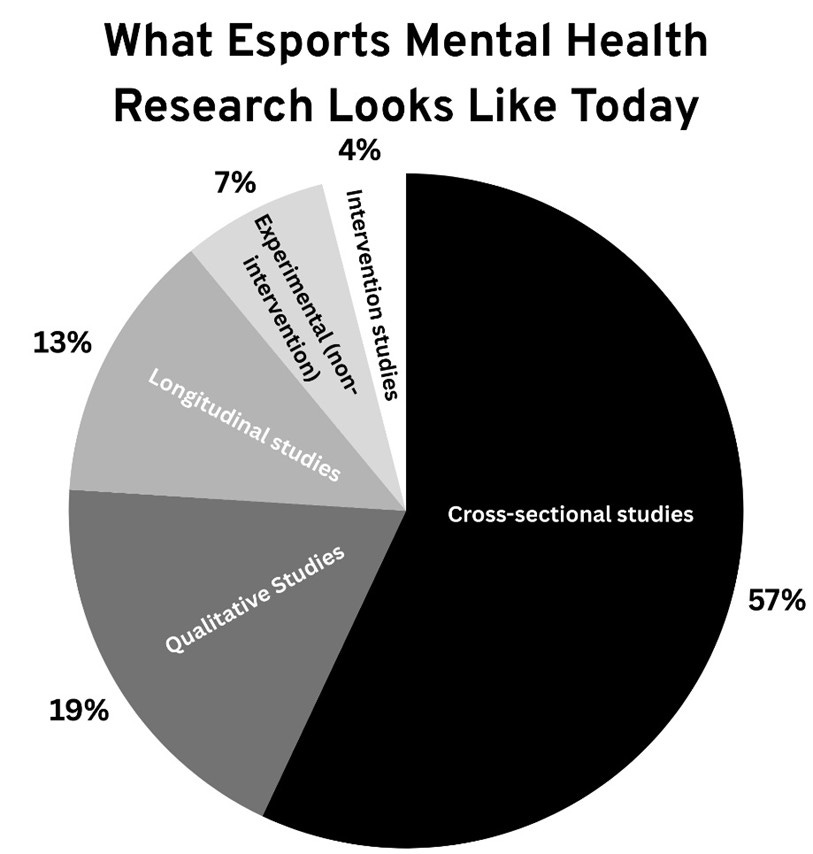
Most esports mental health studies are cross-sectional. In fact, more than 50% of the studies in our review captured only a single snapshot in time, rather than tracking changes in wellbeing over months or years. Fewer than 5% of studies tested interventions, meaning there is currently very limited evidence to guide what actually helps support esports players in practice.
Measurement is another major challenge. Across the 89 studies included in the review, researchers used more than 50 different mental health and wellbeing measures. While appropriate in isolation, this diversity means studies are often measuring related but not identical constructs, making it difficult to compare findings or draw clear, consistent conclusions across the field.
The result is a field rich in signals but short on coordination. We know enough to move beyond speculation, but not yet enough to rely on simple rules of thumb.
A note on men and boys
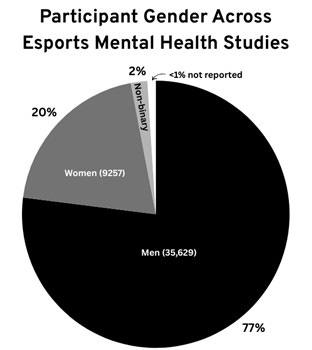
One striking feature of the literature is who is being studied. Across the research we reviewed, ~77% of participants were men (35,629 of 53,696 players). While this reflects participation patterns in competitive esports, most studies stop short of examining how gendered norms, including expectations around toughness, performance, and help-seeking, shape mental health outcomes in these spaces. This represents a missed opportunity in a field dominated by young men.
A growing literature points to men’s distress often being more likely to be externalised, showing up as anger, withdrawal, risk-taking, or antisocial behaviour. In online competitive environments, these signals can be overlooked, normalised, or dismissed as “just part of gaming culture”. This makes it even more important to approach esports mental health with nuance rather than assumptions.
Why guidelines, and what comes next
The evidence points to a clear conclusion: esports mental health cannot be addressed through simple bans, blanket restrictions, or unchecked optimism. The relationship between esports participation and mental health is complex and context-dependent, shaped by how people play, why they play, and the environments in which they play. A fragmented evidence base cannot be translated into action without coordination.
This is where mental health guidelines matter. Rather than reducing esports to questions of “more” or “less” play, guidelines would translate evidence into practical principles for designing and supporting esports environments across players, teams, organisations, and platforms.
This scoping review is the first step in Movember’s guideline development process. By mapping what is known and where the gaps remain, it lays the foundation for a broader co-design effort, including international focus groups with esports players and multiple rounds of structured research with mental health experts, practitioners and sector representatives. Together, these stages are designed to grapple with real-world complexity and identify how players can be better supported in practice.
Esports is neither a mental health villain nor a cure-all. Two things can be true. Recognising that complexity is the starting point for building evidence-informed, context-sensitive mental health guidelines for esports.
Link for paper access: https://doi.org/10.1111/apps.70055