

From Cracks to Foundations: Five Pillars to Transform Men's Health Policy
Introducing 5R, a strategic framework to strengthen policy and deliver lasting equitable change.


Build a house on weak foundations and cracks will always show. For decades, men’s health has rested on shaky ground: temporary pilots, fragmented programmes, and the absence of coherent strategy. Our new paper in The Lancet Public Health introduces the 5R Framework - a model designed to rebuild those foundations.
It extends our earlier 5C Framework for programme design, which set out principles for creating effective interventions on the ground. 5R shifts the focus upstream, offering policymakers a roadmap for systemic reform. And it lands at a pivotal moment. For the first time, the UK Government has committed to a dedicated Men’s Health Strategy. The challenge now is to ensure it provides the structure and ambition to deliver lasting change.
We know the stakes. Men continue to live shorter lives than women, with higher rates of preventable disease, suicide, and late diagnoses of serious conditions. Too many are disengaged from services that were not designed with them in mind. These inequities are not inevitable. They are the result of health systems that have failed to reach and respond to men in ways that reflect their realities.
The 5 Pillars
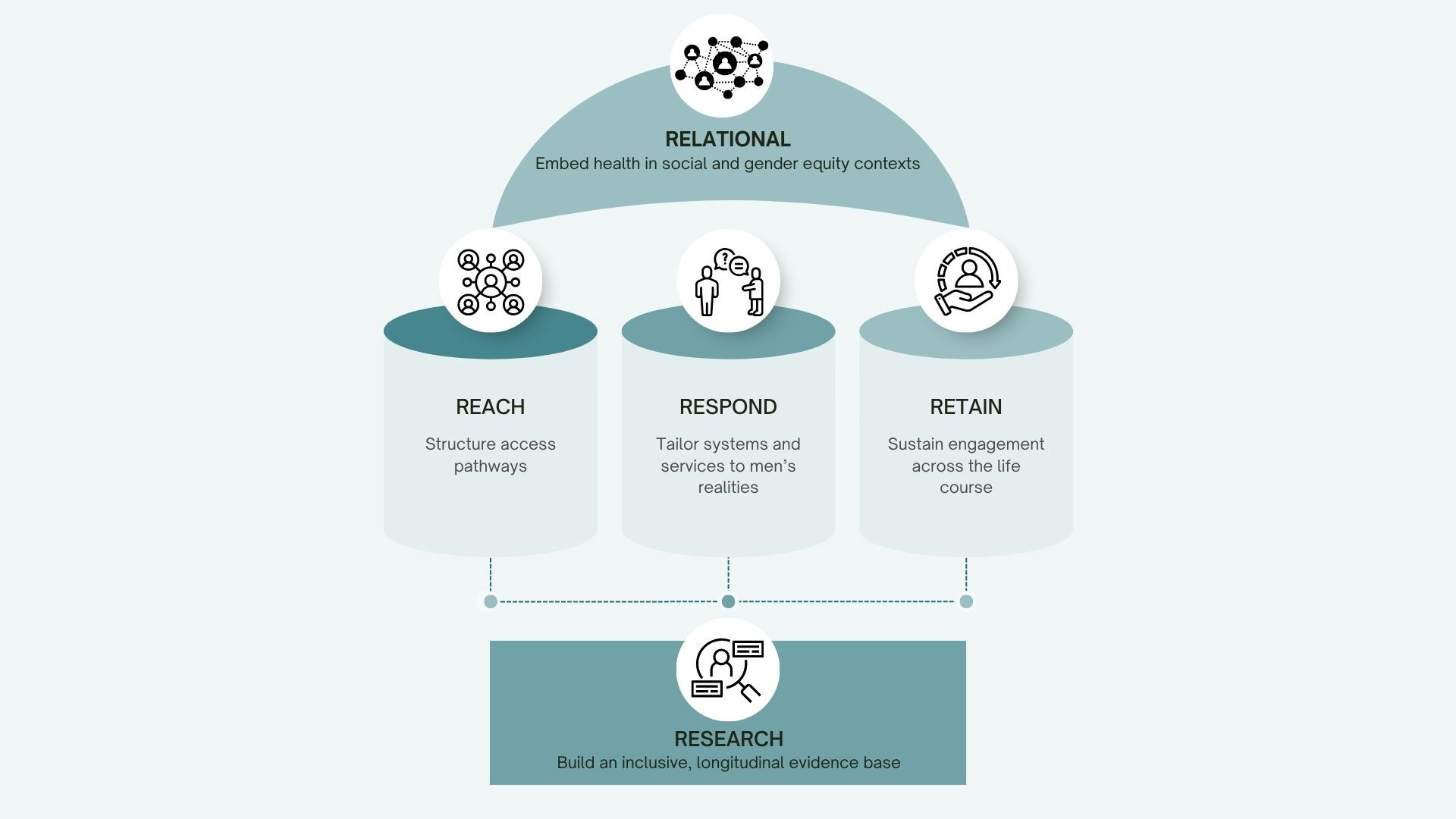
The 5R Framework sets out five pillars for action:
Research: Build an inclusive, longitudinal evidence base that captures diverse men’s lives.
Reach: Create structured pathways that proactively engage men where they are: in workplaces, sports clubs, and digital spaces.
Respond: Redesign systems and services to reflect men’s needs, challenge unhelpful stereotypes, and promote healthier masculinities.
Retain: Ensure continuity and trust so men stay engaged across the life course, not just at moments of crisis.
Relational: Position men’s health within families, communities, and wider gender equity agendas.
Each “R” addresses a structural gap. Together, they provide a roadmap for moving beyond short-term initiatives to embedded, gender-responsive practice at the heart of health systems.
5R calls for a fundamental shift in perspective
The Framework recognises masculinities as diverse, socially shaped, and central to how men perceive health. It moves beyond deficit-based narratives that frame men only in terms of risk, towards approaches that harness men’s strengths such as responsibility, loyalty, and problem-solving. And it positions men not just as patients with problems, but as fathers, partners, colleagues, and community members whose wellbeing supports others as well as themselves.
Opportunity to operationalise the 5R
The UK now has a once-in-a-generation opportunity to follow the lead of Ireland, Australia, and Brazil - countries where national strategies have demonstrated measurable health gains and shifts in practice - but also to go further and set a new benchmark. The upcoming Men’s Health Strategy must sit alongside the 10-Year NHS Plan and wider health reforms, ensuring prevention, community-based care, and digital access are designed with men in mind. Its credibility will depend on whether ring-fenced resources are allocated, cross-sector collaboration is secured, and accountability mechanisms are put in place so that commitments translate into outcomes.
The 5R Framework is offered as a tool to support this work. It provides direction on where to focus and how to measure progress. Like 5C before it, 5R should be treated as a living tool - one that evolves through evidence, practice, and critical reflection. Policy is never static. Its effectiveness depends on how ideas are framed, how power and priorities are negotiated, and how systems learn.
Ultimately, men’s health policy is about more than improving statistics. It is about reshaping the conditions in which men live, work, and connect. A relational approach that recognises men as part of families and communities can drive benefits far beyond individual outcomes, reducing health inequalities, supporting gender equity, and strengthening the social fabric.
Lasting change for men’s health
The UK’s first Men’s Health Strategy will be judged not on the words it contains but on whether it delivers healthier, longer lives for men and boys. Frameworks alone won’t change lives, but without them, strategies drift. The 5R provides foundations strong enough not only for England’s first Men’s Health Strategy to build something lasting, but for other nations considering policy action in this space to draw upon.
 | A guest post by
|
 |
|